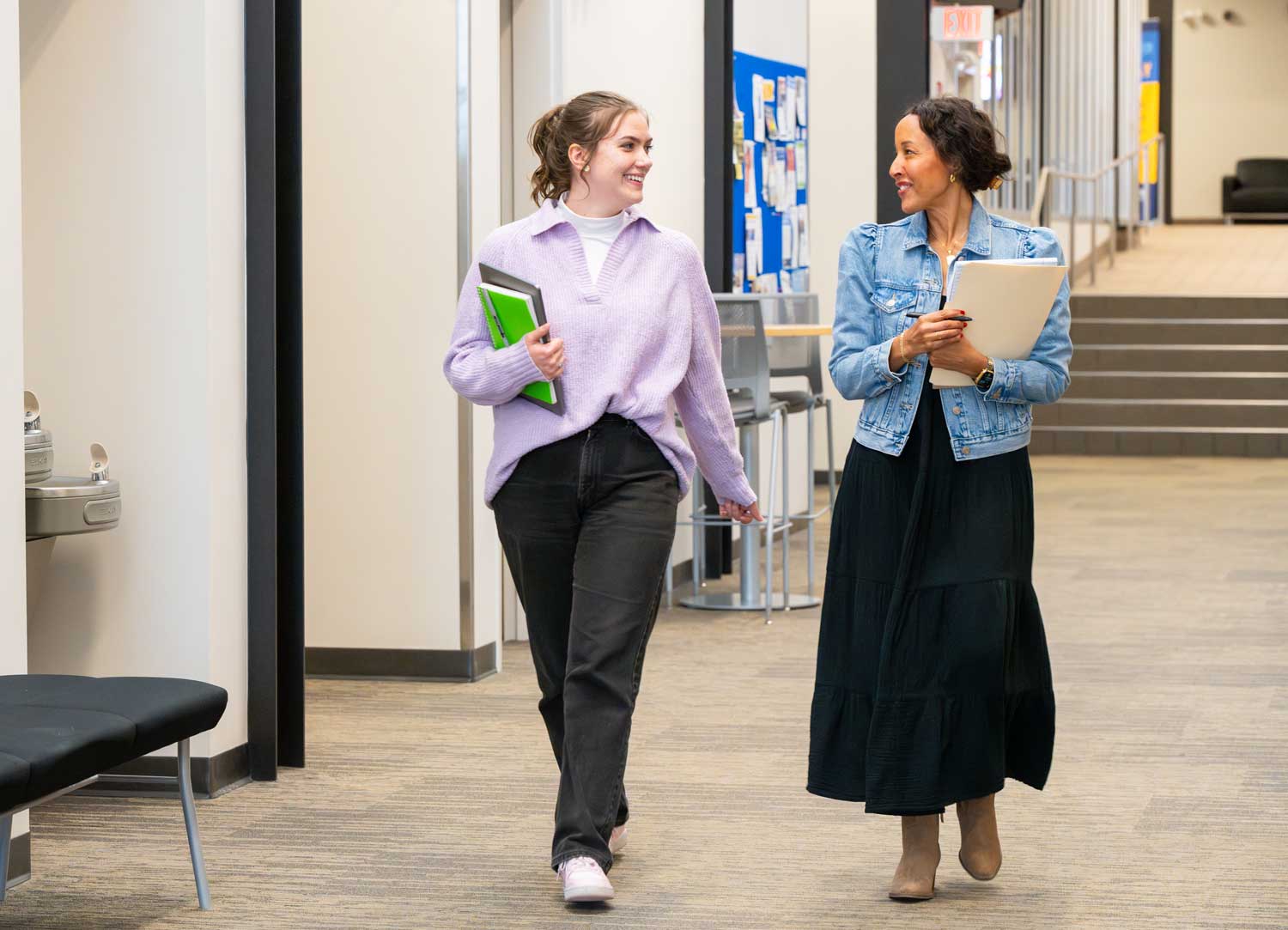
A North Central Michigan College advisor explains how students can save on tuition, transfer college credits, and build a successful path toward a bachelor's degree.
A bachelor's degree doesn't have to begin at a four-year university. For many students, starting at a community college offers a more attainable path to the same goal. The key is knowing which courses to take, how credits will transfer, and how to plan for what's next.
To help students navigate that process, North Central Michigan College recently appointed Shana Kingma as its new director of advising and transfer. In this role, Kingma leads efforts to strengthen academic advising and help students stay on track toward their goals.
We asked her what students and families should know about starting at a community college, transferring to a four-year university, and making informed decisions along the way.
1. Should I start at a community college or a four-year university?
There are several things students should consider, starting with what they know about themselves and their goals. Do you have a career field or major in mind, or are you still exploring your interests? Even if you already know exactly what you want to study and ultimately want to earn a bachelor's degree, starting at a community college can still be an excellent choice.
Cost is an important consideration. If you're still figuring out what you want to study or which college is the right fit, starting at a community college allows you to explore those options while saving a significant amount of money. You can complete many of the same general education courses you would take at a four-year university at a fraction of the cost.
Location and readiness matter, too. Are you excited about moving away, or would you benefit from staying closer to home and building your college experience within a familiar community? Have you visited campuses? Do you have a support network if you move away?
I also want students to recognize the academic opportunities available at North Central. Our faculty are dedicated to providing a strong academic foundation and preparing students for the expectations and rigor of a four-year institution. Starting at a community college doesn't mean compromising on the quality of your education.
2. What mistakes should students avoid when planning for a bachelor's degree?
One of the biggest misconceptions is that earning a bachelor's degree automatically takes four years, just as earning an associate degree automatically takes two. Those timelines require intentional planning, consistent progress, and an understanding of degree requirements. Without a plan, students can spend additional time and money taking courses that don't move them toward their goals.
Another common mistake is assuming they need a bachelor's degree for every career. Some careers can be entered with a certificate or an associate degree, including many of the occupational programs we offer at North Central. On the other hand, students sometimes don't realize that their intended career may require education beyond a bachelor's degree, such as a master's or professional degree. Understanding the educational requirements of a career before choosing a pathway can make a significant difference.
I also encourage students and families not to assume they need to attend a four-year university to complete an entire bachelor's degree. Many students can begin at a community college, complete general education requirements, and transfer those credits toward a bachelor's degree. These are often the same courses students would take at a university, but at a much lower tuition cost.
Finally, don't choose a college simply because it's popular, your friends are attending, or someone else thinks it's the best option. A college that is a great fit for one student may not be the right fit for another. Look at the full cost of attendance, including tuition, housing, and other expenses, and consider the academic and personal support available.
There can also be outside pressure surrounding where a student attends college. Sometimes families place a lot of value on a particular university without fully considering the benefits of beginning at a community college. Even spending a year at North Central can help students strengthen their academic skills, build confidence, and prepare for a successful transition to a four-year institution.
3. How can an academic advisor help students transfer college credits?
Intentional advising can make a tremendous difference in a student's transfer experience. One of the first things we do is help students clarify their goals. What subjects interest them? What careers are they considering? What level of education will they need? Once we understand where a student wants to go, we can begin identifying the educational pathways that will help them get there.
From there, we help students research colleges and universities, identify institutions that offer their intended major or program, and understand admission and transfer requirements. This is where thoughtful course selection becomes especially important. We want students taking classes that count toward their North Central degree while also meeting general education or program requirements at their intended transfer institution. Options like the Michigan Transfer Agreement and our articulation agreements can help make that process more efficient and reduce the possibility of losing credits.
Timing is another important part of the conversation. When is the best time to transfer? What should students accomplish before they leave North Central? How can they make the most of their time and investment?
But advising is about much more than choosing classes. We also help students develop what I like to call "college knowledge." That means learning how to advocate for themselves, ask questions, navigate college systems, find resources, and build connections. These skills help students become more confident and independent as they move into their next educational environment.
Ultimately, our goal is to help students make informed decisions, avoid unnecessary detours, and feel prepared for the next step. We want them to leave North Central with a plan, a sense of direction, and the confidence to keep moving forward.
4. What is the Michigan Transfer Agreement, and how does it work?
The Michigan Transfer Agreement (MTA) is a partnership between Michigan's community colleges and participating public universities that makes transferring general education credits easier. It allows students to complete up to 30 credits of general education coursework at North Central that can satisfy general education requirements at their transfer university.
At North Central, the MTA is incorporated into our Associate of Arts and Associate of Science transfer degrees. Our advising team works with students to make sure they understand the requirements and choose courses that keep them on track, whether they are pursuing the MTA independently or completing one of these degrees.
One of the things I find especially exciting about the MTA is that students can complete the requirements in as little as one year. Think about what that means: A student can begin college close to home, complete most, if not all, of their general education requirements, build academic confidence, and establish a strong foundation before transitioning to a four-year university.
It's a great example of how intentional planning at a community college can help students move forward with both confidence and financial savings.
5. How do North Central's transfer agreements with universities work?
Our articulation agreements are one of the ways we help students connect their education at North Central to their long-term goals. An articulation agreement is a formal, signed agreement between North Central and a partner college or university that guarantees the transfer of the credits in a designated North Central associate degree into a specific program at that partner institution.
We have dozens of these agreements across a variety of academic and career areas, including allied health, business, teacher education, environmental sustainability, natural sciences, writing, computer science, and more.
Some agreements follow a traditional 2+2 model, where students complete two years at North Central and two years at the university to earn their bachelor's degree. Others follow a 3+1 model, allowing students to complete three years at North Central and their final year at the partner institution.
That 3+1 option is particularly exciting because students can earn a bachelor's degree while spending three-quarters of their educational journey at North Central, benefiting from our smaller, more personal campus environment and significantly lower tuition rates.
These agreements provide students with a clearer pathway, greater confidence in how their credits will transfer, and an opportunity to make the most of their educational investment. Our advisors can help students identify which agreements align with their interests and build an educational plan around those opportunities.
6. Can I start at community college if I haven't chosen a major?
This is where I think community colleges can make one of their biggest impacts. North Central is a wonderful place to explore. You don't have to have your entire future figured out before you begin college.
Students can take classes that interest them, complete general education requirements, explore different subject areas, and learn more about their strengths and interests. We encourage students to take advantage of resources like our Career Services department and meet with an academic advisor to talk through their options.
One of the advantages of exploring at a community college is that students can do this at a fraction of the cost of attending a four-year university. They have room to discover what they enjoy, what motivates them, and what kind of career might be a good fit without making an expensive commitment before they're ready.
I also think there is tremendous value in the confidence students build during this process. As they gain experience, develop academic skills, and learn to navigate college, they become better equipped to make decisions about their future. By the time they're ready to transfer, they may have a much clearer sense of where they want to go and what they want to pursue.
Programs like the Michigan Community College Guarantee and Michigan Reconnect can also help eligible students access these opportunities with little to no tuition cost. I would encourage students not to let uncertainty about their major keep them from getting started. Sometimes the best first step is simply giving yourself the opportunity to explore and try things.
7. How has your family's experience shaped your perspective on community college?
I have a unique perspective because I have experienced North Central both as an academic advisor and as a parent. All three of my children began their educational journeys here, and watching their experiences unfold has reinforced so much of what I believe about the value of community colleges.
Their paths were not identical. One of my children knew exactly what they wanted to pursue from the time they entered high school. They came to North Central, earned their degree, and moved directly into their chosen career path. My other two knew they wanted to earn bachelor's degrees but were less certain about their majors. Their time at North Central gave them the opportunity to explore different interests, discover their strengths, and make more informed decisions about where they wanted to transfer and what they wanted to study.
Just as importantly, they developed the confidence and college knowledge to navigate a four-year university. They were comfortable with academic expectations, engaging with faculty, getting involved on campus, and advocating for themselves. They didn't enter their next institution feeling like they were starting from scratch. They had already developed many of the skills and experiences they needed to succeed.
All three went on to earn bachelor's degrees, one from the University of Michigan and two from Central Michigan University. They were able to move into their careers without carrying the level of student debt that many graduates experience.
Their journeys have shaped my work every day. I often tell colleagues and campus leaders that North Central changed my family. As a first-generation college student myself, and the first in my family to earn a college degree, I understand how transformative access to higher education can be. Seeing all three of my children earn bachelor's degrees after beginning right here at North Central makes that belief even stronger.
I don't just believe in the community college pathway because I work in this environment. I believe in it because I've watched it work for my own family.
8. What should parents know about transferring from community college to a university?
I would want parents to understand that transferring is not simply about deciding when to leave one college and start another. It's about making sure students are building toward a degree along the way. There are a few things I wish more families knew.
First, there is no single right time to transfer. Every student's circumstances and goals are different. However, I strongly encourage students to consider earning their associate degree before transferring. Research shows a strong relationship between completing an associate degree and eventually completing a bachelor's degree. Completion leads to completion, and earning that first credential gives students an important milestone along the way.
I also want families to know about reverse transfer. If a student transfers to a university before completing their associate degree, they may still be able to combine eligible credits earned at the university with their North Central coursework to finish that associate degree after transferring. Students don't necessarily have to give up on earning their associate degree just because they've moved on to another institution.
Second, grades matter. Students generally need a C or better in a course for the credit to transfer, and many four-year universities have minimum overall GPA admission requirements of 2.75 or higher. Requirements vary by institution and program, so students should understand those expectations early rather than waiting until they're ready to apply.
Finally, I wish more parents understood how much four-year universities want to support transfer students. Universities are actively working to grow transfer enrollment and offer dedicated transfer admissions counselors, specialized programming, transfer events, and scholarships specifically for transfer students. Students who begin at a community college are not taking an unconventional route. They are following an established pathway that universities recognize and value.
My biggest advice to parents is to encourage your students to ask questions, meet with their advisors, and start planning early. The transfer process can seem overwhelming when you look at the entire journey at once, but the individual steps are manageable. Our advising team is ready to help students and families navigate those steps. It's the intentional planning along the way that makes the biggest difference.
Start planning your transfer with North Central.
Whether you know which university you want to attend or are still exploring your options, North Central Michigan College's academic advisors can help you understand degree requirements, explore transfer pathways and choose courses that support your goals.
Connect With an Academic Advisor
About Shana Kingma, M.A.
 Shana Kingma is the director of advising and transfer at North Central Michigan College,
where she helps students explore academic pathways, plan for successful transfers
and achieve their educational goals. Her advising experience includes working with
scholarship recipients, international students and students with general advising
needs.
A North Central parent herself, Kingma has seen all three of her children begin at the college before earning bachelor's degrees. She brings both professional expertise and personal experience to helping students navigate their college journeys.
- Tags:
- blog